
The 1/12 Mortgage Payment Trick: Small Monthly Extra, Big Long-Term Savings
Some mortgage advice gets old because the market changes.
Some advice gets old because it was never very good to begin with.
And then there are the old tips that survive because they still work.
One of those is the simple habit of taking the equivalent of one monthly mortgage payment, dividing it by 12, and adding that smaller amount to each regular monthly payment throughout the year.
That detail matters.
This is not about waiting until December and making one large extra payment. It is about adding a little extra principal every month so that, over 12 payments, you have paid the equivalent of one additional mortgage payment for the year.
It is not glamorous. It is not a mortgage “hack” in the modern internet sense. It is not something that needs dramatic music, a thumbnail with a shocked face, or a sales pitch attached to it.
It is just math… Good math… Because, in the multi-decade long mortgage game, good math has a way of becoming very real money.
Why This Old-School Trick Still Matters
When most people get a mortgage, they focus on the obvious things first. The home price. The rate. The down payment. The monthly payment. Those are all important, and they should be. But what often gets less attention is the long life of the loan itself.
A 30-year mortgage sounds normal because it is normal. It is the standard frame many buyers expect. But “normal” does not mean “cheap.” A mortgage can do two things at the same time: make homeownership possible and still cost an astonishing amount in long-term interest if left untouched.
That is where the 1/12 extra-payment strategy earns its reputation.
If you add 1/12 of your regular principal-and-interest payment to each monthly payment, you begin attacking principal earlier and more consistently. That matters because mortgage interest is based on the remaining principal balance. The sooner that balance falls, the less interest has time to accumulate.
This is one of the reasons I like talking about the strategy. It is simple enough to understand, but powerful enough to matter.
The Example: A First-Time Buyer on a $400,000 Home
Let’s use a practical example.
Assume a first-time buyer is purchasing a $400,000 home and putting down the minimum 3.5%. That creates a down payment of $14,000 and a base loan amount of $386,000. For illustration, I am using a 30-year fixed interest rate of 6.278%.
Under those assumptions, the monthly principal-and-interest payment comes out to about $2,383.70.
Now take that payment and divide it by 12… The result is about $198.64.
That means if the borrower adds an extra $198.64 to each regular monthly payment, the new monthly principal-and-interest payment becomes about $2,582.34. Over the course of a year, that added amount equals one full extra monthly payment, but it is spread across all 12 payments instead of being made as one year-end lump sum.
Here is what the breakdown looks like:
|  |
What the Difference Looks Like Over Time
This is where the strategy becomes more interesting.
If the borrower simply makes the standard payment of $2,383.70 for the full 30 years, the total interest paid comes to about $472,132.79.
If the borrower adds $198.64 to each regular monthly payment and has that extra amount applied to principal, the loan is paid off in about 24 years and 4 months instead of 30 years. Total interest paid falls to about $367,871.45.
That is a savings of roughly $104,261.34 in interest… Yup, you’re reading it correctly. That is NOT a typo!
That is a major financial difference created by a relatively modest monthly adjustment.
Here is the side-by-side comparison:
| Scenario | Monthly Payment | Payoff Time | Total Interest |
|---|---|---|---|
| Standard payment | $2,383.70 | 30 years | $472,132.79 |
| Payment plus 1/12 extra each month | $2,582.34 | About 24 years, 4 months | $367,871.45 |
In other words, adding just $198.64 to each monthly payment saves more than $104,000 in interest and cuts about 5 years and 8 months off the life of the loan.
Why the Strategy Works So Well
The reason this works so well is not magic. It is timing.
Mortgage interest is calculated on the remaining principal balance. The faster principal falls, the less interest has a chance to accumulate. When borrowers make extra principal payments every month, they are not just “paying a little more.” They are changing the balance path of the loan itself.
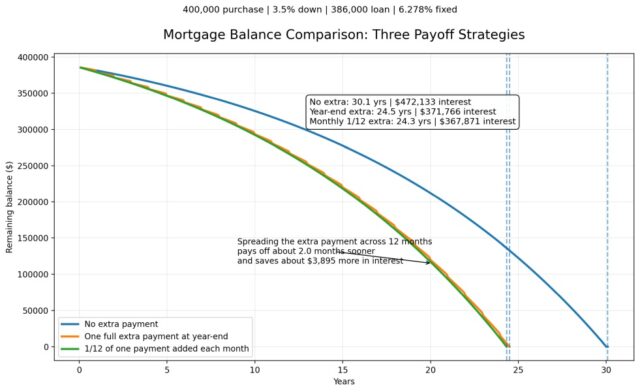
That is exactly what the graph comparing the three scenarios shows. The standard-payment loan declines steadily, the loan with one full extra payment at year-end declines faster, and the loan with 1/12 added monthly performs slightly better because extra principal is being applied earlier throughout the year.
This is one of the reasons I think people underestimate the strategy. An extra $198.64 a month may not feel dramatic in the short term, especially when the full payment is already over $2,300. But over time, that extra amount keeps doing quiet work. Every month it trims principal. Every month it reduces future interest. Every month it nudges the payoff date closer.
Quiet work is still work.
Why Monthly Extra Principal Is Different From a Year-End Lump Sum
I want to be clear about the timing because this is where some people misunderstand the strategy.
The point is not to save up one extra payment and send it at the end of the year. That may still help if the money is applied to principal, but it is not the exact approach I am describing here.
The 1/12 strategy works by spreading the extra payment across the year. Instead of making 12 normal payments and then trying to come up with a 13th payment later, the borrower adds a smaller amount to each monthly payment. In this example, that amount is $198.64.
That monthly consistency matters for two reasons.
First, it is often easier for a household to budget an extra $198.64 per month than to come up with a full $2,383.70 at one time. Second, applying extra principal earlier gives the loan balance less time to generate interest. The difference may not look dramatic in month one, but over years, the effect compounds.
That is why I prefer explaining this as a monthly principal habit, not a year-end stunt.
One Extra Payment and 1/12 Each Month Are Not the Same Thing
This is where I want borrowers to slow down and pay close attention.
Making one extra payment at the end of the year and adding 1/12 of one payment to each monthly payment are not the same thing.
Yes, both approaches may add up to the equivalent of one additional payment over the course of a year. But timing matters. When the extra amount is added monthly and applied to principal, the loan balance begins falling sooner. Since mortgage interest is calculated on the remaining principal balance, paying principal down earlier gives interest less time to accumulate.
That is why the monthly 1/12 method performs slightly better than waiting until the end of the year and making one larger extra payment. In this example, both approaches help. But spreading the extra payment across the year pays the loan off about two months sooner and saves roughly $3,895 more in interest compared with making one full extra payment at year-end.
The difference is not enormous in the first month. It is not even dramatic in the first year. But over time, the math starts to separate.
That is the point.
Make Sure the Extra Money Goes Toward Principal
There is another detail borrowers cannot afford to overlook.
If you send extra money with your mortgage payment, do not assume the loan servicer will automatically apply that extra money to principal in the way you intended.
That assumption can cost you.
Mortgage servicers operate according to their own payment systems, loan terms, and internal procedures. If you send extra money without clear instructions, the extra amount may be applied in a way that does not produce the result you expected. It may be applied toward future payments. It may sit in a suspense account. It may be applied to interest, escrow, fees, or another category before it reduces the principal balance.
And if it does not reduce principal, it does not create the same interest-saving effect.
That is why borrowers should be very specific. When making an extra payment, clearly instruct the servicer that the additional amount is to be applied to principal only. If the payment is made online, look for the option that says “principal only,” “additional principal,” or similar language. If the payment is made by check, write clear instructions on the memo line and include any required payment coupon or written direction the servicer requires.
I would go a step further… Verify it each month.
After the payment posts, check the mortgage statement or online account to make sure the extra amount actually reduced the principal balance. If it did not, contact the servicer and have it corrected. Depending on the servicer, borrowers may need to give this instruction each time they make an extra principal payment. Do not assume last month’s instruction will automatically carry over forever.
Banks and servicers are not charities. They are businesses. They follow systems, payment rules, and financial incentives that may not always line up with the borrower’s best outcome. No pun intended, but interest is where lenders make their money. If your goal is to reduce the interest you pay over the life of the loan, you need to make sure your extra payment is actually reducing principal.
That one detail is the difference between feeling like you are paying extra and actually changing the payoff path of the loan.
What Borrowers Should Remember Before Doing This
The strategy is strong, but it still needs to fit real life.
I would never tell someone to add extra principal at the expense of basic financial stability. A borrower should not be sending extra money to principal while carrying runaway credit card debt, skipping emergency reserves, or running the checking account too tight. A mortgage is important, but so is financial flexibility.
That is why context matters.
For some borrowers, adding an extra $198.64 every month will be very realistic. For others, it may make more sense to start smaller and add extra principal only in certain months. Some people may choose to apply bonuses, tax refunds, or occasional windfalls toward the mortgage instead. The exact method can vary.
The larger principle remains the same: reducing principal earlier generally reduces interest over time.
This Is Not About Being Clever. It Is About Being Intentional.
There is a difference between having a mortgage and managing a mortgage.
Most people know how to have one. They make the payment, move on with life, and let the years pass. There is nothing wrong with that. A mortgage is already a major commitment. But the borrowers who take time to understand even one or two simple strategies often give themselves more options later.
That is what this tip really represents.
It is not a stunt. It is not a trick for people who enjoy spreadsheets more than sleep. It is an old, disciplined, practical habit that can improve the long-term cost of homeownership without requiring a refinance, without depending on future rate cuts, and without pretending the market owes us something better next year.
As your MortgageFriend, let me remind you: hope can make life beautiful, but it should not be your mortgage strategy.
Math is not everything, but in a mortgage, it deserves a seat at the table.
The MortgageFriend View
I like this strategy because it respects the reality of homeownership. It does not assume the borrower can pay the mortgage off in 15 years. It does not assume the borrower wants to stretch to an uncomfortable payment from day one. It simply shows that a manageable extra amount, applied consistently, can materially change the outcome of the loan.
On this example, it means saving more than $104,000 in interest.
That is the kind of result worth paying attention to.
Not every borrower will choose this route, and not every borrower should. But every borrower should at least understand it. Because once you see the numbers clearly, the mortgage stops being just a monthly obligation and starts becoming something you can shape more intentionally.
Talk With MortgageFriend
If you are buying your first home, comparing loan structures, or trying to understand how small payment decisions can affect the long-term cost of your mortgage, MortgageFriend can help you look at the numbers clearly. With a little planning, you may be able to set aside the $200 needed to move this option forward. Afterall, that’s what friends do! We look out for you!
MortgageFriend is a licensed mortgage brokerage providing loan origination services that help borrowers compare mortgage options, understand payment structures, and move forward with greater confidence.
Call MortgageFriend at (877) 239-5312 to start the conversation.